
The V International 04.09.2026
“— See the gopher?
— No.
— Neither do I. But it’s there!”
© DMB
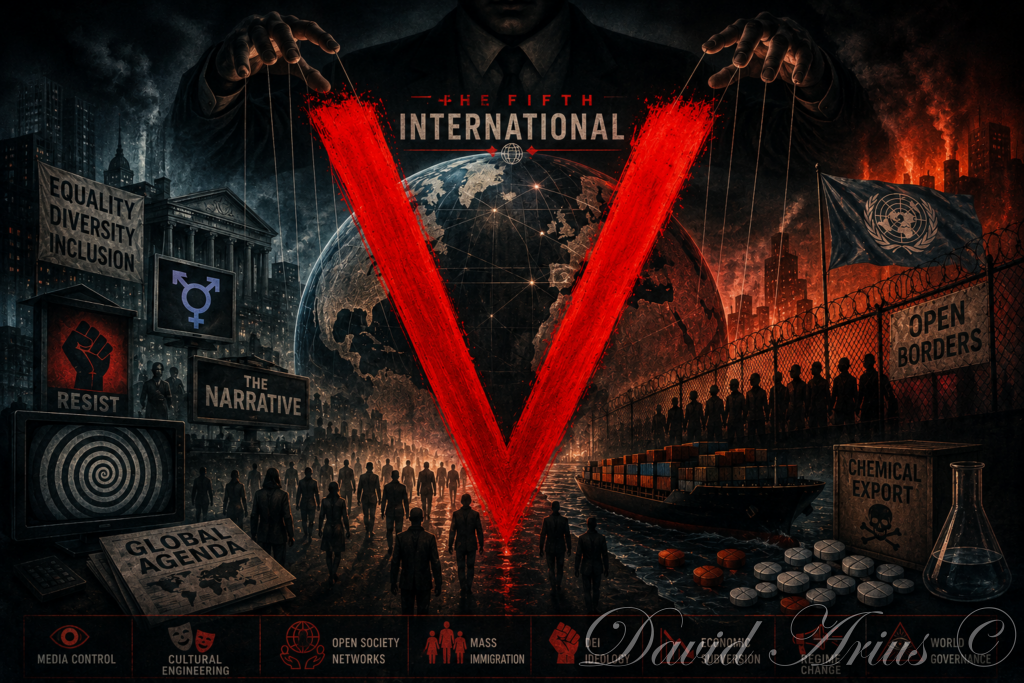
Lately, I’ve found myself using the term Fifth International quite often in various online discussions, and I think it’s worth writing a longer article explaining exactly what I mean by it. Officially, there have been four Internationals.
The First International — 1864–1876. It was the International Workingmen’s Association, associated primarily with Karl Marx and Friedrich Engels.
The Second International — 1889–1916. It brought together socialist and workers’ parties. It effectively fell apart with the outbreak of World War I.
The Third International, or Comintern — 1919–1943. It was created by the Bolsheviks in Moscow after the revolution, united communist parties, and operated under strong Soviet influence. Joseph Stalin dissolved it in 1943.
The Fourth International — founded in 1938 by Leon Trotsky and his supporters as an alternative to Stalin’s Comintern. Various organizations that claim continuity with this movement formally still exist today, including the United Secretariat of the Fourth International, the International Committee of the Fourth International, the International Socialist League, the International Workers League — Fourth International, the Trotskyist Fraction — Fourth International, and several smaller currents.
As the very name suggests, an International inherently laid claim to worldwide reach — to globalism. That was built into both the First and Second Internationals, while the Third International openly proclaimed the goal of World Proletarian Revolution, with the Soviet Union serving as its base. “We stake everything on the inevitability of the world revolution, but this does not mean that we are so foolish as to stake everything on the inevitability of the revolution coming at a definite and early date,” Vladimir Lenin wrote to American workers in August 1918.
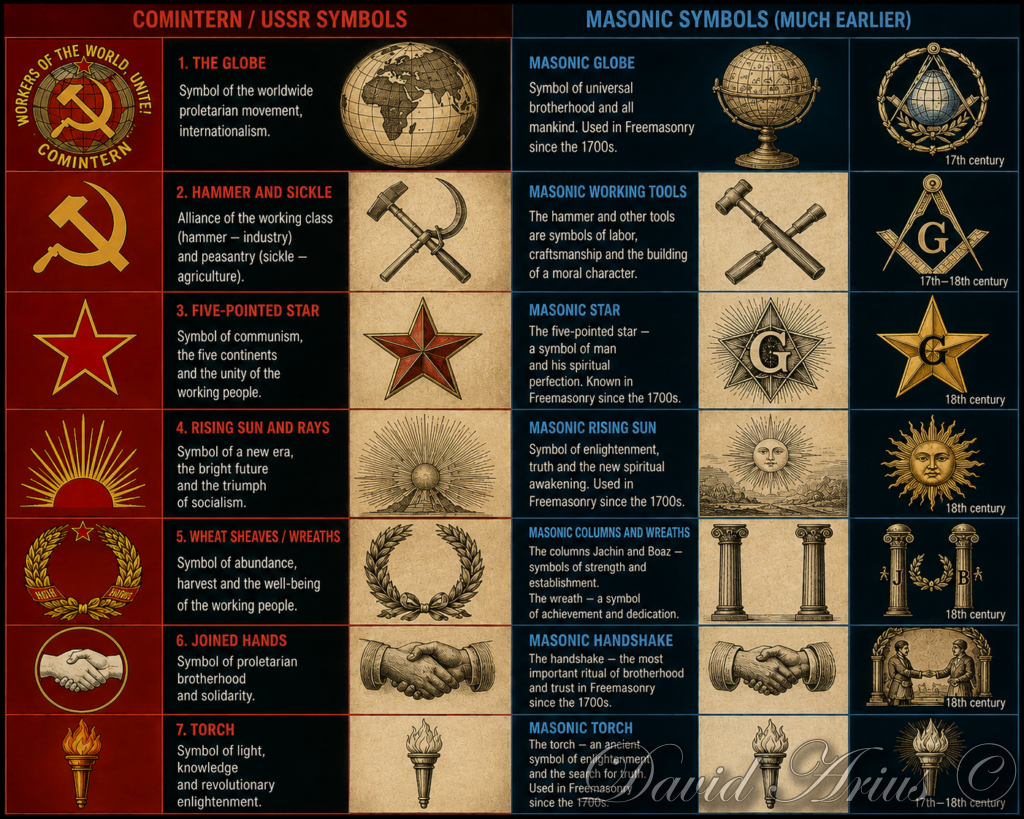
So the goals of the Internationals are clear enough. Even in terms of symbolism, the globalists of the nineteenth and twentieth centuries borrowed quite a lot from the Freemasons, who at one time also had plenty of ideas about World Government.
Neither the First nor the Second International was a wealthy organization. As a rule, they were financed by workers themselves. That changed in the early twentieth century, when the RSDLP(b) began receiving funding from the German government through Alexander Parvus and a number of other channels, primarily for the purpose of destabilizing the Russian Empire. In the end, however, that helped lead directly to the creation of the Third International, which was then financed by the USSR — a state that arose from the ruins of that same Empire, destroyed by the Bolsheviks.
And here it is worth emphasizing the single most important difference between the Third International and the First and Second Internationals, as well as Masonic lodges . The Third International was a centralized structure whose goal was world proletarian revolution. The Second International reached a dead end precisely because it ran into the national orientation of socialist parties in different countries during World War I. Most of the major socialist parties supported their own governments in the war. The German Social Democrats, for example, voted for war credits. To Vladimir Lenin, that amounted almost to a betrayal of socialism. He proceeded from the opposite principle: a worker should not support his own bourgeoisie in a war against workers from another country. From this came the idea of an entirely new Third International, in which all parties would be subordinate to one center and one communist idea. This is exactly where the Third International parted ways with its predecessors, just as any parallels with Freemasonry — parallels that undoubtedly existed in the case of the First and Second Internationals — came to an end.
De jure, during its existence the Third International did not create a single long-lived socialist state. De facto, however, the People’s Republic of China is a direct child of the Comintern, because it was created by the thoroughly Comintern-oriented Chinese Communist Party, and it still exists today. The Mongolian People’s Republic likewise emerged thanks to the Comintern, although it was abolished on February 12, 1992. And this brings us, finally, to the main subject of this article — the Fifth International.
Before that, though, let me say a few words about Leon Trotsky’s Fourth International. The Fourth International set itself the same ambitious goal of “world revolution,” but it never enjoyed any significant support at the state level anywhere. So it is remarkable that this relic of the first half of the twentieth century somehow survived into our era, while such monsters as the USSR itself collapsed long ago. That, essentially, is the only thing remarkable about the Fourth International.
So, the Fifth International.
Officially, the term Fifth International has never been used anywhere. Yes, Hugo Chávez wanted to create some sort of International in 2009, but the idea quickly died, and Chávez himself died along with it. But if something does not officially exist, if no congresses are held and no proclamations demanding “world revolution” are published, does that necessarily mean it does not exist?!
The Fifth International has existed perfectly well in this world almost from the moment Joseph Stalin dissolved the Third International because it was no longer needed. And it has a name. Today, the Fifth International is commonly called “the globalists.”
The point is that the Comintern model exhausted itself through endless splits, constant infighting, and, most importantly, publicity. During World War II, at Tehran in 1943 and Yalta in 1945, the framework of the postwar political order was drawn up, producing a bipolar world: communism led by the USSR and capitalism led by the United States. At the same time, the balance of power between the two camps was roughly equal, and a war between them would have produced consequences for the planet far more global than World War II itself.
At the same time, promoting capitalism inside the USSR — even though the USSR effectively had a form of capitalism under the NEP until 1928 — became dangerous to one’s health, freedom, and life in general. The same was true of promoting communism in capitalist countries — and the United States had an extremely powerful Communist Party until the 1940s, after which it was simply marginalized.
So the struggle moved elsewhere, into the shadows: covert operations, intelligence services, “agents of influence,” and secret funds.
That, essentially, is how the Fifth International appeared.
What is it?
No one has ever given it any formal definition, and the structure itself is so broad and diverse that describing it in standard terms is difficult. So I will explain, in my own words, exactly what I mean by the Fifth International and where I believe it came from. In this part of the article, unlike the previous section, please do not judge me too harshly on the precision of every historical assessment. I may be wrong about certain things or certain people, although overall I believe the picture is accurate.
So, in the second half of the 1940s, the political struggle between the communist and capitalist blocs moves into the shadows. The United States destabilizes the “Soviet bloc” through the promotion of “Western values,” nationalism, and so on. Soviet intelligence services, in turn, establish financial networks in the West through which they finance trade unions, left-wing parties, and activists, while also penetrating educational institutions and the mass media and using those mechanisms to influence public consciousness.
It is important to understand that, in both the Third International and the Fifth International, the USSR served merely as the economic base for World Proletarian Revolution. Marxists did not particularly like Russia itself. Karl Marx, for example, described the development of Muscovite politics as “the Machiavellianism of the usurping slave.”
In other words, the goal of the Fifth International was not to “build socialism in one country,” but the same world revolution.
To achieve that goal, fantastic amounts of money were drained from the Soviet economy to support various left-wing movements and covert “agents of influence” throughout the world. And this produced results. Western countries shifted noticeably to the left. Trade unions and all kinds of rights activists raised their heads. Socialist — and sometimes even communist — parties in capitalist countries operated entirely within the legal political system and built real electoral support.
And the stated goals sounded wonderful: guaranteed workers’ rights, an end to apartheid, universal education, and so on.
The Bolsheviks, incidentally, also had the slogan “Land to the peasants, factories to the workers” in 1917, and that was the banner under which they carried out the October coup. Of course, afterward neither the peasants got the land nor the workers the factories. Instead, there was the GULAG, the Holodomor, World War II, and plenty of other interesting things.
The same process occurred here. Slogans about “workers’ rights” gradually evolved into DEI and 70+ genders, while “the end of apartheid” evolved into BLM marches and the destruction of monuments to American historical heroes.
But here I am getting slightly ahead of myself and jumping toward the end of the article.
China deserves a separate mention.
After Soviet leader Joseph Stalin died in 1953, Chinese leader Mao Zedong was deeply skeptical of the new Soviet leadership, where Nikita Khrushchev came to power in the course of the “bulldogs fighting under the Kremlin carpet.”
“Under the pretext of ‘combating the cult of personality,’ Khrushchev defamed the dictatorship of the proletariat and the socialist system and thereby effectively cleared the road for the restoration of capitalism in the Soviet Union,” Chinese media wrote at the time in publications such as On Khrushchev’s Phoney Communism and Its Historical Lessons for the World.
As a result, after Stalin’s death, China and the USSR went their separate ways.
China then went through the Cultural Revolution and later its own version of the NEP under Deng Xiaoping, during which it became the cheap factory of the Western capitalist system. That same Western system destroyed its own national economy by beginning to relocate manufacturing from its own territory to the PRC, thereby creating the “Chinese economic miracle.”
Naturally, when Henry Kissinger and Richard Nixon opened the political door between the United States and the PRC in 1971–1972, they were motivated by completely different considerations. They saw China as a rival to the USSR and wanted to create a counterweight directly on the Soviet Union’s borders in the form of another hostile socialist state with which the USSR would inevitably have to clash.
But what actually happened was somewhat different.
During those years, the USSR was actively developing the Fifth International, pouring enormous resources into creating a “left-wing” fifth column in the West. Soviet intelligence services worked directly with members of Western elites, some of whom, for example, were even married to female agents of one Soviet-controlled Štátna bezpečnosť or another, the consequences of which we are still dealing with today.
At the same time, the United States was pouring enormous resources into the PRC, which itself was a direct child of the Comintern.
So the USSR was investing resources in making the West move leftward, while the West itself — sometimes at the expense of its own economy — provided the boost behind the “economic miracle” of Comintern-born China.
Well, at that point the communists were winning on every front. No question about it.
As we know from history, no full-scale conflict between the USSR and China ever took place. The USSR, just as Mao Zedong had predicted, completely abandoned communist principles, lost its ideological foundation, and eventually collapsed.
Without a revolution inside the Soviet elite, that process was inevitable, and there was nobody left with either the ability or the incentive to carry out such a revolution.
China, meanwhile, where Deng Xiaoping’s economic reforms began in 1978, followed the path of Lenin’s NEP in economics combined with mandatory complete renewal of the political elite every ten years and, as a result, not only survived the crisis of the 1980s without major upheaval but became many times stronger both politically and economically.
At the same time, China remained almost completely in the shadows on the international stage until the 2010s.
Meanwhile, after the collapse of the USSR, some very interesting developments begin in the West.
Various globalist structures start appearing like mushrooms after rain.
In 1993, the Open Society Institute was officially established in New York. Today it is better known as the Open Society Foundations. Behind this globalist project stood a financier with a very dark past named George Soros.
Incidentally, Soros began his career as a philanthropist in 1979 by financing the education of Black students during apartheid. Subtle, wasn’t he.
Beginning in the early 1980s, George Soros also started funding various grant and scholarship programs for members of the Eastern European intelligentsia and dissidents — apparently the very people who would later begin building modern “socialism” in Europe, while in Russia in 1999 they would bring Vladimir Putin to power, with some of them still playing at maintaining the appearance that a Russian opposition exists.
In addition to his European activities, George Soros also made his mark in the United States, where beginning in 1992 he became the principal sponsor and patron of the Clinton family, and beginning in 2004 became a mega-donor to the Democratic Party.
Essentially, that is the point when the United States finally started heading somewhere it really should not have been heading.
Then, in 2005, the Democracy Alliance was created.
The operating principle of this organization is extremely revealing: instead of simply giving money to the Democratic Party, it finances an entire ecosystem around it.
In essence, this was the birth of a funding network for all kinds of “progressive” organizations in the racial justice / gender justice / equity / inclusion sector.
In other words, that is where the roots of modern DEI and BLM-style movements come from.
Today, through this network of organizations connected to the Democracy Alliance and the ecosystem surrounding it, candidates such as the current mayor of New York, Zohran Mamdani, and others like him have received support.
So when people say communists are coming to power in the United States, it is not really a joke.
They simply are not quite the same communists as actual communists. They are more like the first Komsomol activists and “revolutionary sailors” of 1917, sent out to carry out the “dekulakization” of the “damned bourgeoisie.”
For example, in July 2026, the leadership of the Democratic Socialists of America — an organization independent of the Democracy Alliance but fully aligned with the “progressive” political agenda — publicly confirmed that open U.S. borders are regarded as a long-term political objective.
DSA co-chair Megan Romer, when asked directly whether the movement supported abolishing national borders and granting amnesty to everyone illegally present in the United States, answered: “As a long-term plan — yes.”
She also explained that “open borders are part of a longer-term international plan.”
What open borders do to the security of modern states can be seen in today’s European Union.
Meanwhile, the real communists in China, for some reason, keep their borders closed, immediately deport illegal migrants, and already have facial-recognition cameras flying directly over the heads of all citizens, conscious and otherwise, without discrimination.
So from this point forward, let us examine the actions of the Fifth International and those sympathetic to it through the lens of migration policy.
That is where things get especially interesting.
We can more or less finish with George Soros here.
He and his son Alexander Soros are the most obvious, but far from the only, examples of advocates of the Fifth International.
At the same time, it is worth emphasizing that not every sponsor or activist associated with the Democracy Alliance and related organizations necessarily has to be a communist or a follower of the Fifth International.
Quite the opposite.
What exists there is more like a peculiar club of shared interests, with most participants simply defending certain ideas of their own.
Something similar existed during the early development of Soviet Russia.
There were feminists, free love, and even genuine internal party debate.
But as we all know, eventually all of that turned into the GULAG and a whole series of execution grounds such as Kommunarka.
The People’s Republic of China and the Mongolian People’s Republic, incidentally, went through a similar process of communist development.
Now let us move from the United States to Europe.
And while things in the United States are still more or less normal today, Europe is entering genuinely difficult times.
There we have a massive migration crisis, a war on the eastern borders, and governments in a number of European countries that are prepared to encourage various kinds of “okupas,” leaving their own citizens not only without housing but also forced to pay for the occupiers out of their own pockets.
How did it come to this?
Take Britain.
From 1979 to 1990, under the right-wing Conservative Prime Minister Margaret Thatcher, Britain was a country of net emigration. More people generally left than arrived.
But in the early 1990s, a turning point begins, and it is associated with an English political figure named Tony Blair.
Blair represented Britain’s socialist Labour Party, a party whose history had brought it into close contact with the Third International.
But Tony Blair did not stop there.
When he became Labour leader in 1994, he immediately launched radical party reforms and proclaimed New Labour.
In 1995, Blair secured the rewriting of Clause IV of the Labour Party constitution, whose old wording had proclaimed an aspiration toward “common ownership of the means of production, distribution and exchange.”
New Labour abandoned that principle as its central economic objective.
Instead, Blair embraced the market economy, private business, and entrepreneurship.
So at first glance, what we appear to be seeing is precisely a departure from communist principles.
But what won’t one do for the prime minister’s chair?
On May 1, 1997, the now more centrist Labour Party achieved the largest victory in its history, winning a record 418 seats in the House of Commons.
Tony Blair, having secured among other things the support of Rupert Murdoch’s media empire, became prime minister and remained in Downing Street for more than ten years — longer than any other Labour prime minister in British history.
Speaking of Rupert Murdoch.
In his youth, he was interested in left-wing ideas, was a member of the Australian Labor Party, and even displayed a bust of Vladimir Lenin prominently in his room.
Before becoming a global media magnate — and today the Murdoch family owns media companies such as Fox Corporation and News Corp, including publications like The Wall Street Journal, New York Post, The Times, The Sun, and others — Rupert Murdoch had worked with both Australian socialists and British Conservatives.
But in 1997, it was Rupert Murdoch personally who instructed his media organizations to support New Labour instead of the Conservatives, whom he had supported since 1979.
And that, to a significant degree, helped produce Labour’s extraordinary electoral success.
So what happens to migration in Britain after that?
Before 1990, migration was often negative. Before 1997 and Tony Blair, it fluctuated between negative and slightly positive levels.
Under Blair, the Primary Purpose Rule was abolished, the Human Rights Act was passed, the doctrine of Managed Migration was introduced, and more than a dozen other measures were adopted that made immigration into Britain easier.
As a result, in 2007 — Tony Blair’s final year as prime minister — immigration into the United Kingdom reached 577,000 people.
Since 2022, that figure has exceeded one million people every year, in a country with a total population of roughly 70 million.
In essence, a foreign takeover of Britain began with the full systemic support of the country’s own authorities.
Now let us go to France.
Unlike Britain, France had already practiced large-scale recruitment of immigrants between 1945 and 1974.
These were primarily labor migrants from Europe, invited to help rebuild the French economy after World War II.
In 1974, that program was terminated, and the share of immigrants in France remained virtually unchanged until 1999 — from 7.4 percent in 1975 to 7.3 percent in 1999.
So what happened?
What happened was this.
In 1997, Lionel Jospin’s left-wing government came to power in France and radically changed the tougher immigration policies of Jacques Chirac’s previous governments.
First, in June 1997, an exceptional regularization program for illegal migrants began.
It applied, among others, to families, spouses of legal residents and French citizens, certain students, and several other categories.
Then came the Chevènement Law of May 11, 1998.
It strengthened protections for private and family life, changed the grounds for residence permits, and altered family reunification rules.
For example, the law established the right of a legally resident foreigner, after a certain period of time, to bring in a spouse and minor children provided certain income and housing requirements were met.
As a result, since 2004 officially registered immigration into France has exceeded 200,000 people per year.
Since 2018, the figure has exceeded 300,000.
And again, that is in a country with a population of around 70 million.
And it should be understood that we are talking only about officially registered people.
How many Africans and Arabs arrived by boat and then disappeared into ghettos across France is something no one really knows.
At the same time, France gives us a classic example of convinced far-left socialists coming to power.
What makes Lionel Jospin particularly interesting is that he was not a follower of the Third International or the early Fifth International, as Soros was, for example.
He was a follower of the comparatively rare Fourth International.
In the 1960s, Jospin was associated with the French Trotskyist organization Organisation communiste internationaliste, led by Pierre Lambert, and from there went on to build his political career.
Yet the result was the same as with socialist Tony Blair in Britain.
Now let us go to Germany.
The still-divided Federal Republic of Germany, like France, had been forced after World War II to seek foreign labor to rebuild the country.
The inflow of foreign workers continued from 1955 to 1973.
Then, as in France, it stopped.
In East Germany, naturally, migration policy was completely different, and we will not discuss it here because the phenomenon was insignificant by comparison.
Modern changes in German immigration policy are directly connected to the rise of Chancellor Gerhard Schröder — yes, the same man who would later become Chairman of the Shareholders’ Committee of Nord Stream AG, whose controlling stake belonged to Russia’s Gazprom.
Gerhard Schröder came to power in 1998 as leader of the left-wing Social Democratic Party of Germany, but formed a coalition government with the Greens, who were also an entirely left-wing party.
So what changed in immigration law, and what consequences followed?
For decades before Gerhard Schröder, beginning in 1973, the political doctrine of West Germany could roughly be summarized as:
“Deutschland ist kein Einwanderungsland.”
“Germany is not a country of immigration.”
Under Schröder, that logic begins to change:
Immigration is a permanent phenomenon → Germany needs certain categories of immigrants → the state should manage their recruitment → permanently resident foreigners should be integrated → citizenship should become more accessible to their children.
The first fundamental step was the reform of German citizenship law in 1999/2000.
Previously, the German system had been based primarily on jus sanguinis — citizenship by descent.
The Red-Green government introduced an element of jus soli: under certain conditions, a child born in Germany to foreign parents could acquire German citizenship at birth.
The law was passed in 1999, and its main provisions took effect on January 1, 2000.
The second step was the Green Card program of 2000.
Schröder personally announced at CeBIT a program designed to attract foreign IT specialists.
That was an important signal: after decades of restricting labor migration, Germany was once again deliberately recruiting workers abroad.
The third and perhaps most ideologically important step was the Süssmuth Commission.
Interior Minister Otto Schily created an independent immigration commission in 2000 headed by Rita Süssmuth.
In 2001, it published the report Zuwanderung gestalten – Integration fördern.
Its basic premise was perfectly clear:
“Deutschland braucht Zuwanderinnen und Zuwanderer.”
“Germany needs immigrants.”
Research by the Federal Institute for Population Research describes the developments that followed as a fundamental transformation of German migration policy.
Finally, the culmination was the Zuwanderungsgesetz, which came into force on January 1, 2005.
It created a new systematic framework for residence, labor migration, and integration.
For the first time, state integration programs were brought together into a unified system, with integration courses as the central element.
Incidentally, unlike Britain and France, these reforms did not produce an immediate effect.
Explosive growth in immigration to Germany began only after the “Arab Spring.”
Since 2012, immigration into Germany has exceeded one million people annually, and since 2022, following Russia’s invasion of Ukraine, that figure has been slightly above or close to two million per year, in a country with a population of approximately 84 million.
There is no point in going over who Gerhard Schröder is, how he came to power, his connections to Vladimir Putin and Russia, and so on.
Everything is clear enough already.
Almost identical developments also took place in Spain, Italy, Sweden, and several other European countries.
The algorithm is always the same: a left-wing government comes to power, migration policy is loosened, strict laws against “racism” and criticism of immigration are introduced, and then immigration explodes.
In some places, the growth begins almost immediately, as it did in Britain.
In others, external artificial “triggers” are required, such as the “Arab Spring,” artificially created by the same Fifth International.
At the same time, the migration statistics I cited above are gross immigration figures — simply the number of people who arrived.
There is little point in using the NET figure, because those arriving are generally Arabs, Eastern Europeans, and Africans, while those leaving are the countries’ own native-born citizens.
In reality, therefore, the replacement of Europe’s titular populations is even worse than what I have described here.
Studying migration is also a path toward understanding the most obvious and most dangerous source of threat to European civilization today.
Over a historically very short period — thirty years — Europe has undergone fundamental ethnic and religious changes in its population.
If that continues, it will inevitably produce a catastrophe with fatal consequences.
Naturally, migration is not Europe’s only problem.
Europe also faces economic problems caused by the activities of the Fifth International, but I no longer see much point in discussing all of that in detail.
Another interesting thing worth mentioning is the surprisingly anti-Zionist orientation of the Fifth International — anti-Zionist in every sense of the word “Zionism.”
The Third International, for example, consisted to a significant extent of Jews.
The Fourth International was founded by the Jew Leiba Davidovich Bronstein, better known as Trotsky.
Yet the left-wing followers of the Fifth International constantly criticize Israel from every media outlet and every political platform.
Why?
For some reason, Jews themselves associate the creation of the modern State of Israel with the Rothschild dynasty.
There is Rothschild Boulevard in Tel Aviv, and Edmond de Rothschild appeared on an Israeli 500-old-shekel banknote issued by the Bank of Israel in 1982.
The Rothschild contribution to the establishment of Jewish settlements in Palestine was undoubtedly enormous.
For example, after the anti-Jewish pogroms in the Russian Empire of 1881–1882, Baron Edmond James de Rothschild began financing Jewish migration to Ottoman Palestine and the establishment of Jewish settlements there.
Then came the Balfour Declaration in Britain in 1917, associated with Lionel Walter Rothschild, 2nd Baron Rothschild.
And in 1924, French Baron Edmond James de Rothschild established the Palestine Jewish Colonization Association and placed his son James Armand de Rothschild at its head.
PICA was involved in land acquisition and development, agriculture, and economic projects.
The Rothschild contribution to the establishment of Jewish settlements in Palestine was invaluable.
But they had nothing to do with the actual creation of the State of Israel.
Modern Israel as a state was created by Joseph Stalin and the Soviet Union.
In essence, just like the modern People’s Republic of China.
How did that happen?
After World War II, the British prepared to leave Palestine, and the newly created United Nations faced the question of what should happen to the territory.
At that point, Joseph Stalin adopted an unexpectedly favorable position toward the creation of a Jewish state.
On May 14, 1947, Andrei Gromyko delivered an extremely important speech before the United Nations General Assembly on the future of Palestine.
The Soviet Union’s initial preference was for a single Arab-Jewish democratic state.
But Gromyko explicitly stated that if peaceful coexistence between the two peoples within one state proved impossible, the partition of Palestine into two independent states — one Arab and one Jewish — should be considered.
And that is what happened.
On November 29, 1947, the General Assembly adopted Resolution 181 — the partition plan for Palestine.
It provided for the creation of a Jewish state and an Arab state, while Jerusalem was to receive a special international status.
The USSR supported the partition.
And here the arithmetic matters.
The resolution required a two-thirds majority among the states participating in the vote.
The Soviet bloc was therefore a key part of the coalition that allowed the plan to pass.
In addition to political support, without which the State of Israel could never have appeared legally, there was also significant military support from the Soviet bloc.
After Israel declared independence on May 14, 1948, war broke out with neighboring Arab states.
At that moment, the young Israeli state desperately needed weapons.
Czechoslovakia, already firmly within the Soviet sphere of influence, played an enormous role.
Czechoslovak deliveries included small arms, ammunition, and aircraft.
Israeli official sources note that the first arms deliveries began as early as January 1948, and that by November 80 aircraft had reached Israel.
Around 200 Israeli specialists, pilots, and paratroopers were also trained in Czechoslovakia.
That means the Soviet bloc did not merely help Israel diplomatically.
It helped Israel survive militarily during a critical moment in the 1948 war against the Arabs.
Why did Joseph Stalin need any of this?
For the same reason he created communist China.
Jews had been a driving force of the Third International and of the Bolshevik Party as a whole.
At the same time, enormous numbers of Jews lived in the USSR, and the issue of creating a “Jewish republic” had been extremely acute.
Israel, meanwhile, stood at the intersection of the geopolitical interests of all the major world powers: Britain, France, Turkey, and the United States.
At the same time, the kibbutz system already practiced by Jews in Palestine — which differed little from Soviet collective and state farms — together with the powerful Histadrut trade union movement and the dominance of the socialist Mapai party made Israel an ideal potential principal ally of the USSR in the Middle East.
Only a few things remained to be done: recognize Israel, protect it from the Arabs, and then resettle part of the Soviet Jewish population there.
But the project of a communist Israel failed almost immediately.
When socialist David Ben-Gurion became the first prime minister of the State of Israel, he suddenly declared that he was not a communist at all.
Meanwhile, in 1949, the United States began extending credit to Israel.
In 1950, Israel supported the UN/U.S. position in the United Nations against North Korean aggression, which was supported by the USSR and the PRC.
That was already a direct break with the Soviet Union, and the break deepened rapidly.
In February 1953, after a bomb exploded on the grounds of the Soviet mission in Tel Aviv, the USSR severed diplomatic relations with Israel and then shifted its search for regional allies toward the Arab states.
The modern Fifth International remembers all of this, and life for present-day Israel is becoming more and more entertaining by the day.
On the subject of Israel and the Jews, I will add one more perspective of my own.
If it had not been for pro-Soviet Jews such as Julius Rosenberg, Ethel Rosenberg, Theodore Hall, Harry Gold, and others, it is doubtful that the Soviet Union would have acquired nuclear weapons in 1949.
And without that, who knows how world history would have unfolded.
And now, I think it is time to bring this article to an end.
A great deal has already been written.
So let us simply summarize what the Fifth International is and what all of us should expect from it.
The Fifth International is not an official movement or political force.
It is a general term I created for all political, media, and economic forces in the world that, in one way or another, pursue radical left-wing policies.
That includes migration, the subject matter of mass media and film, and the promotion of certain values and patterns of behavior.
The Fifth International is a hidden destructive force aimed at gradually dismantling the foundations of democratic world powers — while exploiting all the weaknesses of democracy itself — in order to degrade and ultimately destroy them.
The Fifth International itself has neither a unified ideology nor any single defined center.
It is a collection of many different movements, ranging from the modern British Labour Party to LGBT+ and Greta Thunberg.
The Fifth International emerged to covertly advance the interests of the USSR at the beginning of the second half of the twentieth century and had no difficulty surviving the Soviet Union itself.
Moreover, with the disappearance of the “Soviet threat” and the weakening vigilance of Western political elites, it effectively emerged from the shadows in the 1990s and gradually, through the broad network of left-wing movements established earlier, infected Europe’s leading economies.
In the early 2000s, it began gradually taking over the United States as well.
At the same time, the Fifth International has so far encountered no serious resistance.
In Europe, people who publicly criticize migration policy receive large fines and, in some cases, prison sentences.
Meanwhile, in politics, the principle “If you can’t beat them, lead them” is applied to forces holding the opposite position.
For years now, European right-wing parties — which inevitably should be gaining political weight against the backdrop of the migration and economic crisis caused by the actions of the Fifth International — have been firmly associated with Russia and the fascist regime of Vladimir Putin ruling there.
These include Alternative for Germany, Le Pen’s National Front, Lega, FPÖ, and others.
At the same time, agents of influence of Russian intelligence who work with these organizations and promote them in the media operate freely in both Europe and the United States, enjoying all the political and security protection they need from the Fifth International.
It is not difficult to identify the state whose interests the Fifth International now serves.
It is the People’s Republic of China — the direct heir of the Third International.
At the same time, China itself remains detached from the Fifth International.
And while, for example, one can trace destructive Chinese actions against the United States through the supply of chemical precursors to Mexico for local cartels, which then flood America with mephedrone and fentanyl, the actions of the Fifth International are hidden behind the façade of human rights, democracy, minority freedoms, and so on.
Just as the British Empire flooded China with opium in the nineteenth century, China is now flooding the United States with mephedrone and fentanyl.
Just as the United States once tried to defeat the Soviet Union by supporting all kinds of dissidents, nationalists, and other “free artists,” today the Fifth International puts senile old men with “Soviet tails” from the Leonid Brezhnev era into the president’s chair.
And next, apparently, will come the era of a body-positive queer Black woman with an enormous cellulite-covered ass sitting in the chair of the head of the Pentagon.
But there is only one thing history teaches us that really matters:
The Bolsheviks always come to power under slogans like “Liberty! Equality! Fraternity!” or “Land to the peasants!”
But once they get that power, what inevitably follows is not freedom.
It is the GULAG.
Dmitrii Ershov, political scientist.
Tags: Global Politics | V International